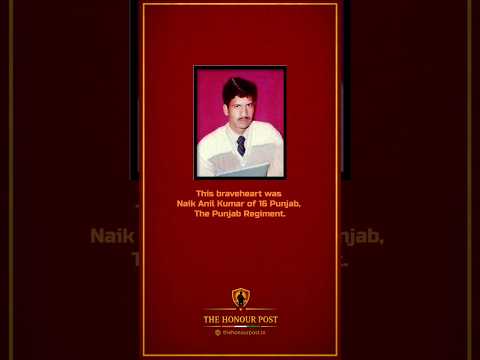
When Sepoy Rajinder Singh went on duty with the Indian Army in Jammu and Kashmir, his family had no way of knowing that he would never return home. On 1 November 1998, while serving with 22 Punjab Regiment in the Poonch sector, he made the supreme sacrifice while fighting terrorists during Operation Rakshak. His gallantry was later recognised with the Shaurya Chakra, awarded posthumously.
But his story is not only about the uniform he wore or the operation in which he lost his life. It is also about a young family whose future changed in a single day, and a son who was born months after his father's sacrifice and would grow up without ever meeting him.
Service with 22 Punjab
Sepoy Rajinder Singh served with 22 Punjab Regiment of the Indian Army. In 1998, his unit was deployed in the Poonch sector of Jammu and Kashmir, an area that witnessed counter-terrorism operations during a difficult period of insurgency.
On 1 November 1998, Rajinder Singh was engaged in an operation against terrorists under Operation Rakshak. According to his widow, Palwinder Kaur, he made the supreme sacrifice after eliminating four terrorists during the operation.
His courage and service were subsequently recognised by the nation with the Shaurya Chakra (Posthumous), one of India's peacetime gallantry awards.
A Family Left Waiting
At the time of his sacrifice, Rajinder Singh's wife, Palwinder Kaur, was five months pregnant. The news of his death changed the course of her life, leaving her to face motherhood without the support of her husband.
Their son, Ravinder Singh, was born approximately four months after his father's death. He would grow up hearing about the man whose photograph remained a part of his family, but whom he never had the opportunity to meet.
For Ravinder, his father's identity was tied to the uniform, the regiment and the sacrifice that had taken place before he was born. For Palwinder, the loss was that of a husband whose return she had once awaited.
The Family's Long Struggle
More than two decades after the sacrifice, the family's difficulties came into public attention.
In a report published by The Wire in July 2020, Palwinder Kaur spoke about the family's struggle to receive government assistance under Punjab's Honour and Gratitude Policy. She said that her husband had sacrificed his life while eliminating four terrorists and questioned why the family continued to face difficulties despite his gallantry award.
Their son, Ravinder Singh, was then 21 years old and pursuing the matter of assistance and employment with the state government. The report highlighted how the policy's eligibility conditions had left several families of pre-1999 peacetime gallantry award recipients outside its benefits.
The issue was not a reflection of Rajinder Singh's military service, but of the difficulties his family continued to face long after his sacrifice.
A Gallantry Award and an Enduring Legacy
The Shaurya Chakra awarded to Sepoy Rajinder Singh posthumously stands as recognition of his courage and service. Yet, behind the medal is a family story that deserves equal remembrance.
His wife carried the burden of his absence, while his son grew up without the opportunity to know his father personally. The years passed, but the memory of the soldier who did not return remained with them.
On 1 November, we remember Sepoy Rajinder Singh of 22 Punjab Regiment, who made the supreme sacrifice during Operation Rakshak in the Poonch sector of Jammu and Kashmir in 1998.
His courage was recognised with the Shaurya Chakra. His story must also be preserved so that future generations know the soldier behind the award, and the family whose lives were forever changed by his sacrifice.
The Honour Post pays tribute to Sepoy Rajinder Singh of 22 Punjab Regiment. We honour his courage, remember his service and salute the family that continues to carry his memory.